
If you have any warts on your feet, you may have come across this article while searching for an effective treatment. Warts can occur in both adults and children, although they are more common in children.
Children often contract viral infections such as molluscum contagiosum or warts, which are commonly associated with swimming pools (although going to the pool is not a prerequisite for contracting either infection, since they are spread through skin-to-skin contact, which can occur in many other circumstances).

Today I’ll be discussing treatments for plantar warts, more commonly known as papillomas (although that term isn’t entirely accurate) and caused by the human papillomavirus (HPV).
Shoud foot warts be TREATED?
Viral warts (all of them, not just papillomas, which is the term we use to refer to viral warts on the feet) tend to go away on their own. Up to 2 out of every 3 of them may disappear spontaneously within 2 years. Therefore, simply monitoring them without treatment is a perfectly valid option.
Patience is a key factor in the treatment of papillomas
In any case, even knowing this, we usually want to get rid of them as soon as possible, which is why certain treatments exist to remove them. However, patience is a key factor in the treatment of papillomas, since getting them to disappear can take weeks or months and may require the use of different treatments.
Furthermore, removing a papilloma does not 100% prevent it from reappearing or another one from developing in a different area of the skin.
What TREATMENTS are available for papillomas?
Unfortunately, there are not enough studies to clearly define the steps to follow when treating plantar warts. It’s important to note that no single treatment is effective in all cases, so guaranteeing success with any of them is difficult. It’s also important to keep in mind that in immunocompromised individuals (those with weakened immune systems due to an illness or medication they’re taking), the response to treatment is usually poorer.
No treatment for papillomas is effective in 100% of cases
The two treatments with the most scientific evidence are wart removers and cryotherapy with liquid nitrogen. There are no studies demonstrating the superiority of one over the other.
• TOPYCAL TREATMENTS:
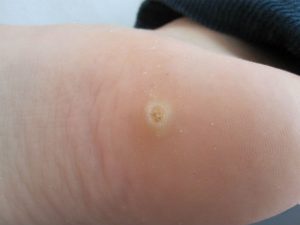
These are formulations containing salicylic acid at various concentrations. Some well-known examples include (Verufil®, Isdin® Wart Remover, Quocin®, Vaselix®, Verruplan®).
Salicylic acid is a “keratolytic,” meaning it breaks down keratin, which is the main component of the skin’s outermost layer—a layer that is considerably thicker in warts and papillomas. By gradually breaking down the keratin, the papilloma is eliminated. It is recommended to file or scrape the area before application or to soak your feet in hot water to soften the skin, allowing the medication to penetrate more effectively.
Studies have demonstrated its effectiveness when used over several weeks.
These treatments should not be used on people with diabetes or other forms of peripheral neuropathy because they are unable to feel pain if the area is damaged excessively.
• CRYOTHERAPY:
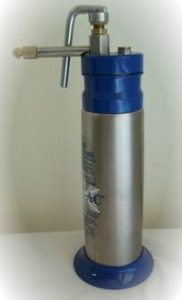
To perform cryotherapy, we use liquid nitrogen, which is at -196°C. Applying it freezes the wart very quickly, and as it thaws, it damages the cells, causing the wart to be destroyed.
It is a painful procedure that lasts about one minute. In the hours that follow, the area becomes more sensitive and may turn red, swell, or even develop a blister under the wart. All of these symptoms are normal and will gradually subside. If the treatment has been successful, the wart should disappear within about two weeks.
Products such as cryopharma®, sold in pharmacies, do not contain liquid nitrogen, but rather a mixture of dimethyl ether and propane (DMEP) that freezes only down to -57°C. There is virtually no scientific evidence regarding the effectiveness of these products. Therefore, they should not be recommended as a standard treatment for papillomas or other types of warts.
• OTHER TREATMENTS:
In cases where these two treatments do not work, other options can be considered, such as imiquimod, 5-fluorouracil, bleomycin, formalin, cantharidin, immunotherapy, etc.
None of these has sufficient scientific evidence to recommend them as a first-line treatment (and they are generally more expensive), but with papillomas, in some cases, the approach involves trying different treatments until one works.
Papillomas can be removed using ablative laser therapy, which can destroy tissue without leaving a scar. However, no matter how refined the technique or how advanced the laser technology, removal does not guarantee that the lesion will not reappear.
Can foot warts be PREVENTED?

It is known that HPV is transmitted through direct “skin-to-skin” contact, and in this regard, it is advisable to avoid direct contact between the papilloma and other areas of your skin or the skin of other people. In any case, treating a papilloma does not eliminate HPV; it only removes the wart. Therefore, a person who does not currently have a wart or papilloma may still be able to transmit the virus, since the virus remains on their skin.
There are no scientific studies that clearly examine the risks of transmission, nor are there guidelines for appropriate preventive measures. In any case, common-sense precautions—such as wearing flip-flops on shared floors in sports facilities or swimming pools—may be advisable.
