If you have recently been to the dermatologist and they have recommended a skin biopsy, you may be wondering exactly what this involves. I will try to describe it in this article.
What is a skin biopsy?
A biopsy involves taking a small piece of skin so that it can be studied by pathologists. They examine this skin under a microscope and extract more information from it than we can obtain with the naked eye during a clinical examination.
A biopsy involves removing a small piece of skin for analysis under a microscope.
The pathologist’s report will clear up any doubts in many cases, and in others it will provide us with information that complements what we dermatologists obtain during the consultation, so that by combining both sources it is easier to reach an accurate diagnosis.
When is a skin biopsy performed?
Many skin diseases can be diagnosed with the naked eye (psoriasis, acne, dermatitis, rosacea, etc.), but there are times when we may not be sure what we are dealing with. The same can happen with some moles or lumps on the skin. We recommend a biopsy in these cases, where information from pathological anatomy can be key.
How is a skin biopsy performed?
A skin biopsy is a simple procedure that is often performed in the doctor’s office. Here are the steps involved:
- To perform a skin biopsy, we anesthetize the area we want to study so that the procedure is not painful. This is done by giving a small injection in the area, usually with a fine needle that causes slight discomfort when it pricks the skin. A small amount of anesthetic is injected, which may cause a burning, stinging, or slight pain sensation. This lasts only a few seconds, as the anesthetic takes effect relatively quickly and the area of skin becomes numb.

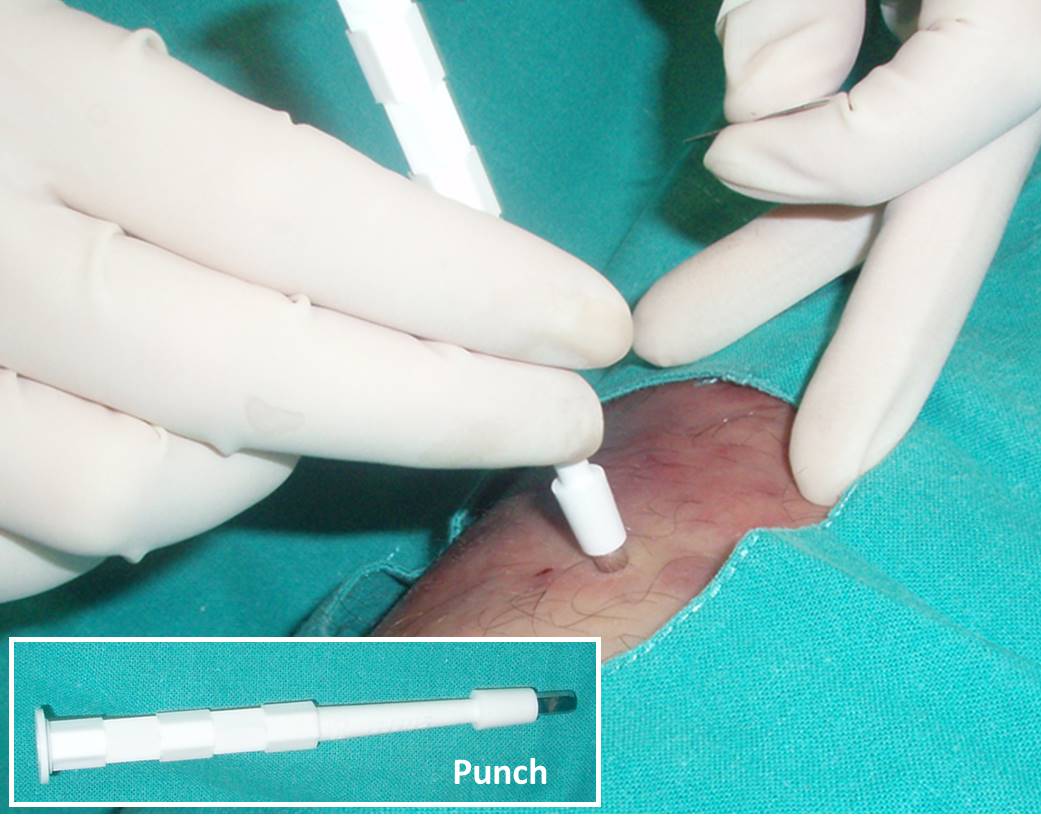
- Once the skin has been anesthetized, we take the small piece of skin. This is usually done with an instrument called a “punch,” which allows us to extract a perfect cylinder of skin between 3-6 mm, depending on the case. Sometimes the piece of skin is simply cut out with a scalpel.

- The wound is usually closed with one or more stitches. Sometimes, if the biopsy is small, stitches may not be necessary.


What precautions should be taken after the biopsy?

In the days following the procedure, you should take care of the wound and avoid sudden movements to prevent it from opening up. The wound can get wet, so you can shower as normal, and your dermatologist may recommend applying an antiseptic or antibiotic to the area.
The stitches are usually removed between 5 and 15 days after the biopsy. Your dermatologist will tell you the exact time frame, as it depends on the area of the body where the biopsy was performed and your specific case.
What complications can a skin biopsy have?
Complications from a skin biopsy are very rare. In any case, before the biopsy, it is important for the dermatologist to know if you have any allergies and what medications you are taking.
Like any wound, a wound caused by a skin biopsy has the potential to become infected. This does not normally occur if we follow the instructions and aftercare properly.
Infection or bleeding, although rare, are the most common complications following a skin biopsy.
Similarly, as with any wound, there is a (very low!) risk of bleeding in the hours following the procedure. Normally, if this occurs, the bleeding will stop simply by applying continuous pressure to the area for 15 minutes.
In rare cases, the stitches may open in the days following the biopsy, which is usually linked to excessive strain or stretching of the skin where the biopsy was performed.
In summary…
A skin biopsy is a simple, quick, and low-risk technique that is sometimes extremely useful to dermatologists in reaching a diagnosis and prescribing appropriate treatment.
I would like to thank my colleague and friend Sergio Vañó for the photos for this article, without which I would not have been able to clearly illustrate the biopsy process.
