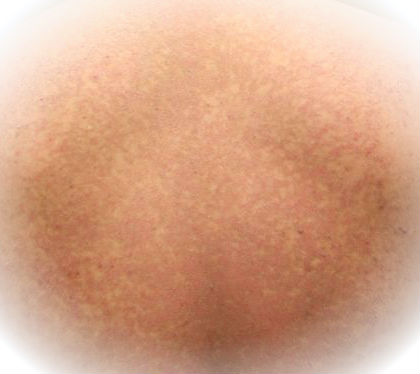
Today’s post is about a condition that is more common in summer and often leads to visits to the dermatologist. It is called pityriasis versicolor and is a non-serious condition caused by a fungus that lives on our skin.
WHAT IS PITYRIASIS VERSICOLOR?
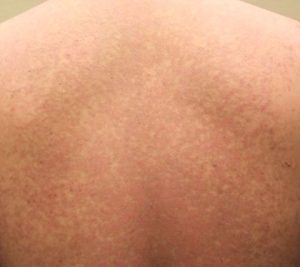
Pityriasis versicolor appears as spots that do not itch or hurt, usually located on the trunk or arms, although they can also appear on the face or body folds. It is more common in adolescents and young adults.
The name “versicolor” comes from the fact that these spots can be different colors: pink, brownish, or white. These spots may be scattered or may join together to form larger spots. When you scratch the spots with your fingernail, you may see a white flake come off. Here you can see images of pityriasis versicolor.
It does not normally cause discomfort, although some people report slight itching.
Pityriasis versicolor is much more common in tropical areas than in northern regions. In our environment, it is most frequently seen during the summer months.
WHY DOES IT APPEAR?
Pityriasis versicolor is caused by fungi of the Malassezia genus, which is saprophytic flora on human skin (this means that it lives normally on our skin and needs the fats in it to survive). Due to factors that are not very clear (sweating, skin sebum composition), in some people Malassezia proliferates and forms these spots.
During the summer, it prevents the area where it is located from pigmenting, which is why white spots that are lighter than healthy skin are usually seen, while in winter (when there is no sun exposure) they are usually pink or orange, darker than normal skin.
In summer, white spots are usually seen, while in winter they are reddish or brownish.
There are other skin conditions that can resemble pityriasis versicolor, so it is a good idea to consult a doctor (consulting a dermatologist online is a good option) to confirm the diagnosis.
HOW IS IT TREATED?
The treatment for pityriasis versicolor is simple. In most cases, it is sufficient to apply a cream, spray, or gel to the spots for a few days. These products contain antifungals (antibiotic for fungi such as ketoconazole, terbinafine, ciclopirox, selenium sulfide) that eliminate them from the skin’s surface. In rare cases where the spots are very extensive or there is no improvement with creams, gels, or sprays, the same drugs can be taken orally. To assess which treatment is best in each case, it is advisable to see a dermatologist.
Treatment is simple, but the spots may persist for weeks or months after treatment is completed.
It is important to know that in most cases, the spots do not disappear immediately after treatment. It is normal (especially in the case of white spots) for them to last for weeks or months after treatment. This is how long it takes for the skin to regain its normal pigmentation, but we must know that the process is cured and exercise patience until everything returns to normal.
ARE THERE ANY PRECAUTIONS TO TAKE?
Contrary to popular belief, pityriasis versicolor is not contagious.
People who are particularly prone to pityriasis versicolor can apply the treatment preventively every month or every two weeks to prevent it from appearing so frequently.
