
Rosacea is a common condition in our environment. It is estimated that up to 10% of the adult population may have it in some form. Next, I will discuss the relationship between this condition and the Demodex mite. Have you heard of it?
What causes rosacea?
Although we diagnose it frequently and have treatments available to control it, it is striking that we still do not know its exact cause. This is frustrating for both patients and us dermatologists.
Rosacea is considered to be a chronic inflammatory skin disease that evolves in flare-ups. It seems that there may be a certain genetic predisposition; that is, if someone in your family has rosacea, you may be more likely to suffer from it. Simply put, there are two main characteristics: redness and red pimples.
It is known that there are two main factors involved in rosacea. On the one hand, there is increased skin inflammation (related to receptors called TLR-2 (toll-like receptors) and molecules called cathelicidins. On the other hand, it is thought that certain microbes may also play an important role: the mite Demodex folliculorum and the bacterium Bacillus olenorium (which in turn lives in Demodex).
What is demodex folliculorum?
Demodex folliculorum is a mite that lives on our skin. It has eight legs and a tail-like appendage called an opisthosoma. It thrives in areas with high sebum production and is therefore found mainly in the follicular openings (pores) on the face.
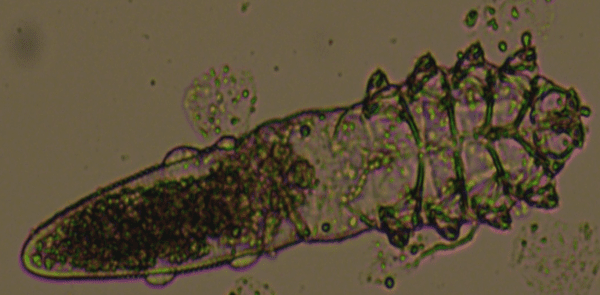
We are born without demodex on our skin, and as we grow, they colonize us through contact with other people.
Demodex and rosacea
It has been proven that people with rosacea have a higher number of Demodex mites in their pores than people without rosacea. What is unclear is which came first, the chicken or the egg.
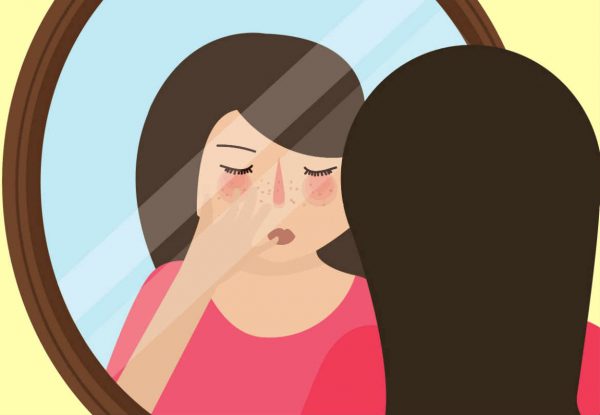
It is unclear whether skin prone to rosacea facilitates the growth of more demodex mites (as it is redder, has more blood flow, which makes it warmer and more comfortable for the mite) or whether these mites cause the inflammation characteristic of rosacea. It is also unknown how much of the blame lies with the mite itself and how much with the bacterium Bacillus olenorium (which colonizes Demodex), as rosacea often improves with antibiotics (antibiotics would destroy the bacteria, but not Demodex).
Pityriasis folliculorum and rosacea
In any case, despite the controversy surrounding the cause, we know that in many cases using a treatment that eliminates demodex can significantly improve rosacea.
This approach has usually been associated with papulopustular rosacea, i.e., rosacea that predominantly appears as red pimples on the cheeks.
However, pityriasis folliculorum is particularly interesting, as it causes a rough skin surface with white “plugs” in each pore in people with the typical redness we attribute to rosacea. These plugs correspond to the opisthosomes of the mite that protrude from the follicular opening.
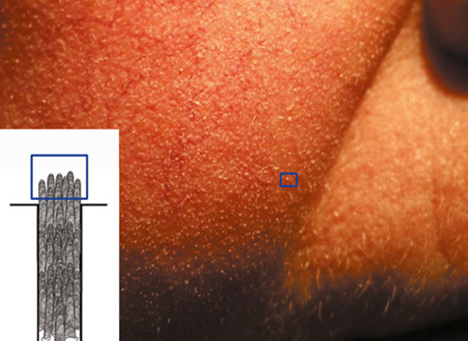
In these cases, treatment to eradicate Demodex (e.g., ivermectin) indirectly achieves not only the elimination of these “blackheads,” improving texture, but also greatly reduces redness and sensitivity.
Here you can read more about pityriasis folliculorum and demodex.
In conclusion…
The evolution and response of skin redness after treatment for pityriasis folliculorum (which consists of eliminating demodex overgrowth) suggests that this mite is more a cause than a consequence of rosacea.
Demodex would influence not only cases of rosacea with inflammatory pimples, but also less severe cases in which only some redness is visible on the skin.
