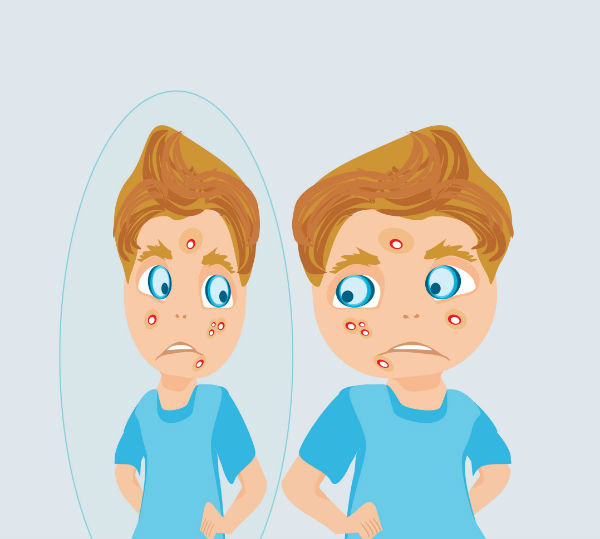
I have discussed acne treatment on numerous occasions in this blog. I have talked about acne in adult women, in girls with polycystic ovary syndrome, and the relationship between chocolate and acne. I also dedicated a post to isotretinoin (Acutane®), currently the most effective treatment available.
But the reality is that acne vulgaris is the most common form, affecting up to 90% of adolescents, more frequently boys, and in most cases disappearing after the age of 20. In women, it is more common for it to persist beyond adolescence.
Acne is more common in boys and tends to disappear after the age of 20.
In any case, even though it tends to disappear, it usually causes some (in some cases significant) discomfort in the person who suffers from it, and therefore treatment is necessary. Even though it is the most effective treatment, not all people with acne require isotretinoin (acutane®), either because their acne is not mild, because they do not want to take pills, or because it is summer and they will be exposed to the sun. What treatment options are available in these cases?
1-General measures
- Before using any treatment, it is advisable to wash your face with a mild soap specifically designed for acne-prone skin.
- If you use cosmetics and/or makeup, it is important that they are oil-free or labeled as oil-free/non-comedogenic.
- Reducing your intake of foods with a high glycemic load could help you control your acne. You can find more information in the post on the “Influence of diet on acne.”
- If your doctor prescribes any topical treatment (cream or gel), it is very important that you use it consistently. If you don’t follow the treatment, it definitely won’t work ;)
2-If you have blackheads and small pimples…

When acne consists of small pimples, in the form of comedones (blackheads) and blackheads, the most commonly used creams are topical retinoids (tretinoin, adapalene), which I discussed in a previous post, as they are also anti-wrinkle treatments. These treatments regulate the production of keratin, which is the substance that usually “clogs” the pores, promoting the formation of pimples. Some cosmetic treatments such as facials or peels can complement the treatment.
Retinoids can cause skin irritation and some people do not tolerate them very well. In these cases, other creams containing salicylic acid or azelaic acid can be used. However, if they are well tolerated, they can be used for a long time and can help us control pimples and blackheads easily.
3-If you also have RED PIMPLES…
Some people, in addition to pimples and blackheads, have redder spots, which sometimes have a white head. Some of these spots can even be painful.
If this is the case, in addition to retinoids, it is advisable to use a treatment that destroys the bacteria involved in acne, Propionibacterium acnes. It may be useful to use benzoyl peroxide, if not already used, or antibiotics (usually clindamycin or erythromycin). There are creams that contain both products together (retinoid + antibiotic -Treclinac®- and retinoid + benzoyl peroxide -epiduo®/tactuoben®-) for ease of use.
4-Sif you have MANY RED PIMPLES or acne is also located on your CHEST and BACK…

When pimples are more noticeable or if there are pimples on the back or chest, antibiotic tablets are usually used, as it is difficult to treat all these areas with creams or other topical products alone. The most commonly used oral antibiotic is doxycycline, which is both antibacterial and anti-inflammatory. It should be used for a maximum of 3 months. A recent study found that there was no difference in improvement between using it for 3 months or 6 months, so there is no justification for prolonging treatment as this can lead to bacterial resistance.
Oral antibiotics are useful when acne appears on the chest and back.
In recent years, there has been an increase in bacterial resistance to antibiotics. To prevent this, it is recommended not to use antibiotics as the sole treatment for acne, either in cream or oral form. In general, it should be recommended in conjunction with a benzoyl peroxide cream, as this has been shown to reduce the number of resistant strains.
5-If you have many red, inflamed, PAINFUL pimples and/or SCARS…
In these cases, dermatologists usually prescribe isotretinoin (Roaccutane®), since, apart from the discomfort caused by the pimples, the risk of lifelong scarring makes us seek the most effective treatment.
In conclusion…
There are currently various treatments available for acne. Cosmetic products alone are not usually sufficient to cure it, but they can be a good complement in some cases. It is best to have a dermatologist examine your type of acne and recommend the most appropriate treatment for your case.
Do you have doubts about your acne?
Consult with me ONLINE and I will advise you on the best option for you.
