I dedicated my last post to milia cysts, and as a result, a reader asked me about another type of “little bumps” that appear on the body—in this case, red ones. Well, they’re called ruby spots, and they’ll be the focus of today’s post.
What are RUBI SPOTS?
Ruby spots are also known by other names, such as senile angiomas, capillary angiomas, cherry angiomas, or Campbell–De Morgan spots (named after the dermatologist who first described them).
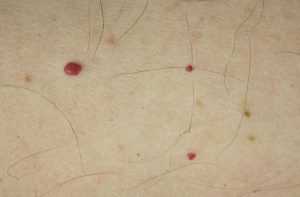
These are small, bright red lesions measuring 1–4 mm that typically appear mainly on the trunk and limbs. They occur in adults, most commonly in those over 50, although they can also be seen in younger people. They do not itch or cause any symptoms.
WHY do red spots appear?
They can be considered a normal part of the skin’s aging process, and hormonal factors are believed to play a significant role in their development, though their exact cause remains unclear. It is common for several members of the same family to have them.
Ruby spots are benign and do not indicate any underlying disease.
In any case, it is clear that they are not caused by any infection, so they are not contagious, nor do they reflect any internal disease that could cause problems. We can consider them “healthy skin.”
HOW are rubi spots diagnosed?
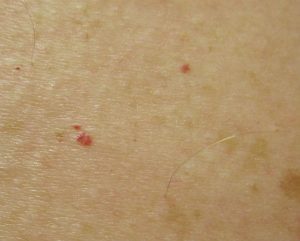
It is very easy to identify ruby spots. They must be distinguished from certain types of moles, other types of angiomas, or petechiae; however, a clinical examination is usually sufficient, and it is very rare for a dermatologist to need to use any special techniques to diagnose them.
How are rubi spots TREATED?
Ruby spots respond very well to laser treatment and can also be treated with electrocoagulation. Both are quick and simple methods that can make them disappear.
They can be treated with electrocoagulation or laser therapy, but there is no preventive treatment.
Unfortunately, there is no known treatment that can be used to prevent more from appearing.
