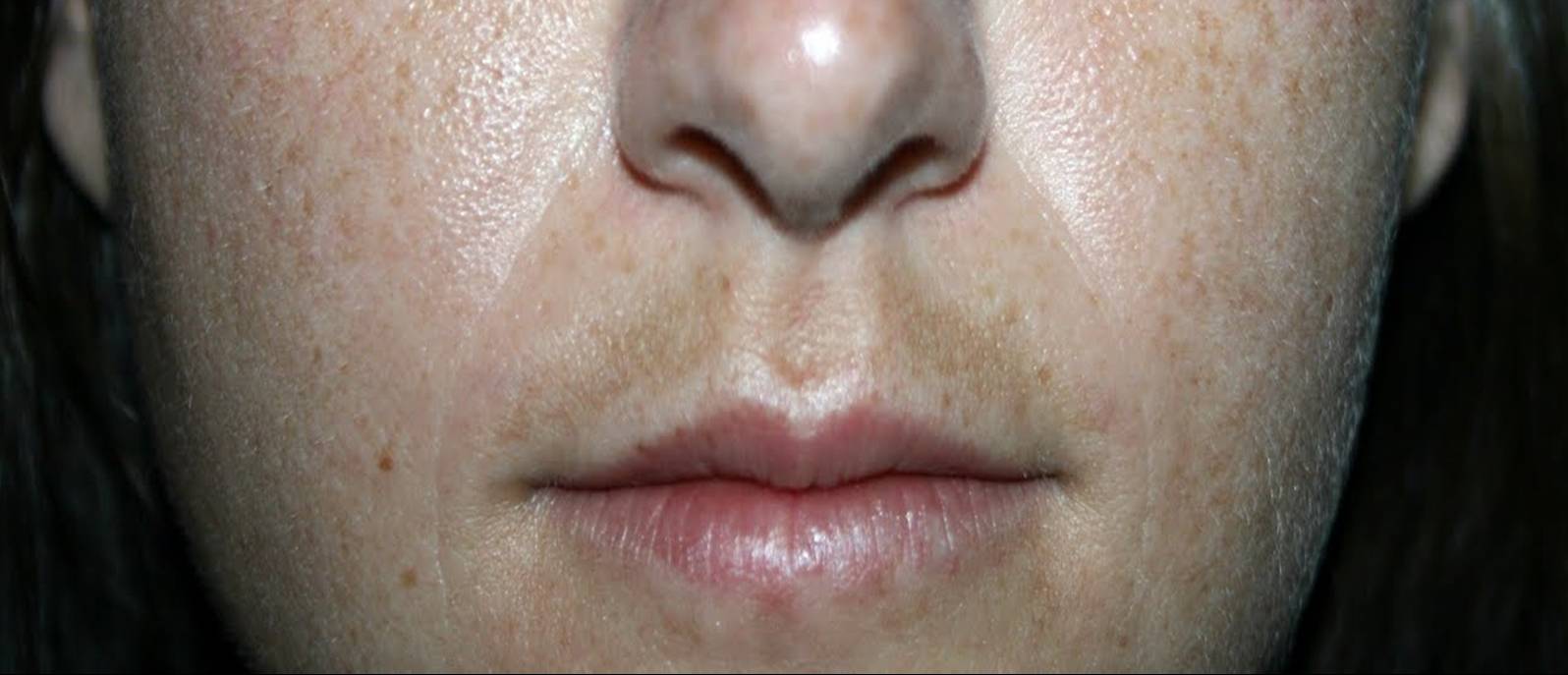
In the summer, it’s very common for patients to come to our offices concerned about the appearance of skin spots, especially on the face. There are many different types of facial spots, but in this post I’ll focus on those known as melasma, since they tend to appear during the spring and summer, while in many cases they are barely noticeable during the winter.
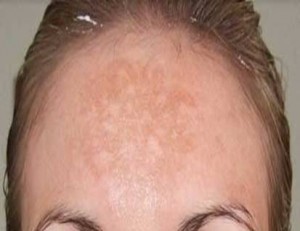
WHAT IS MELASMA?
Melasma (or chloasma) refers to the dark patches that appear—most commonly in women of childbearing age—symmetrically on the cheeks, upper lip, bridge of the nose, or chin.
In any case, it is advisable to consult a dermatologist, as there are other types of spots similar to melasma that must be distinguished from it (lentigines, post-inflammatory hyperpigmentation, drug-induced hyperpigmentation, ochronosis, pigmented contact dermatitis, and poikiloderma).
WHY DOES MELASMA OCCUR?
The exact cause is unclear.

On the one hand, since it is more common during pregnancy or in women taking oral contraceptives, it is known that hormones play a role. In any case, it can also occur (and in fact is quite common) in women who do not fall into either of these two categories; therefore, there must be other factors involved that we do not yet understand.
On the other hand, melasma is more common in people with darker skin, who generally have a higher risk of hyperpigmentation. Therefore, skin tone also influences the likelihood of developing it: the darker the skin, the higher the risk of developing melasma.
Pregnancy, birth control, having darker skin, and sun exposure are the main factors involved in melasma.
Finally, we know that the key trigger for melasma is the sun. This is evident because the spots appear exclusively in areas exposed to the sun (for example, it is extremely rare to see them under the chin). Sunlight is composed of different types of waves. It is well known that ultraviolet (UV) radiation increases skin pigmentation, but in the case of melasma, you may have noticed that even visible light can stimulate its formation, which makes prevention very difficult.
HOW IS MELASMA PREVENTED?

As you might guess, the most important factor in preventing melasma is sun protection. People prone to melasma should use a sunscreen with SPF 50+ daily and reapply it if they spend more than 2 hours in the sun.
Since we know that UV radiation isn’t the only factor involved in melasma, sunscreen alone may not be enough to prevent it completely, as it protects against UV rays but not against visible light. Therefore, it’s advisable to minimize sun exposure and wear a cap or hat during the hours you spend outdoors each day.
HOW IS MELASMA TREATED?
Typically, depigmentation treatments are not performed during the summer, and we focus on preventing the appearance of new spots. In any case, sun protection in itself is already a form of treatment.
As a complement, there are sunscreens—in the form of makeup with varying levels of coverage—that can help us conceal uneven pigmentation during the summer, while also preventing this pigmentation from worsening.
Treating melasma is not easy, but we have various options that are typically started after the summer.
Treating melasma is complex: sun protection must be combined with topical depigmenting products for several weeks. In cases where this is not effective, chemical peels or laser treatments may be used. But we’ll address all these options in due time—once the summer season is over, when the sun is less intense and we can get down to business treating the dark spots on the face.
