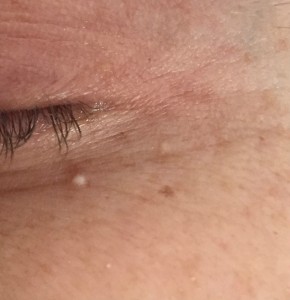
Recently, several friends have asked me what those little white bumps are that appear near their eyes or on their cheeks. The answer is that they are milia cysts, and in the vast majority of cases, they don’t pose any health risks—beyond whether or not we like having them.
But let’s talk about this in a little more detail:
WHAT are the milium cysts
They are small, whitish bumps about 1 mm in diameter that appear spontaneously on the cheeks and, more commonly, around the eyes. They are less common on the forehead and even rarer in the genital area, although they can appear there as well.
Here you can see more photos of milia.
WHY do milium cyst form?
Milium cysts originate from what are known as “pilosebaceous follicles”—that is, the “pores” through which fine hairs and skin oils emerge. It is believed that damage to or blockage of these follicles causes these small cysts to form.
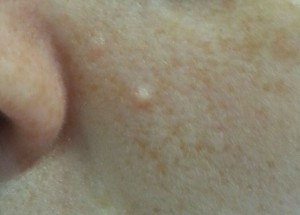
They can appear spontaneously (most commonly) or following skin damage (such as burns or certain skin conditions that cause blisters), on scars, after prolonged use of strong corticosteroids, or following the use of certain medications. In any case, they most often appear “out of the blue,” without any clear cause. Some people are more prone to them than others.
In newborn babies, it is very common to see milia cysts on the face or even inside the mouth (“Epstein’s pearls”) or on the palate (“Bohn’s nodules”). In this case, it is believed that they appear due to the immaturity of the sebaceous follicle.
HOW do milium cysts DEVELOP?
Milium cysts in newborns disappear on their own within a few weeks; therefore, no treatment is necessary.
In babies, they disappear on their own, whereas in adults they usually persist.
In older children, adolescents, and adults, milium cysts typically persist. They usually do not cause any symptoms or discomfort, other than purely cosmetic concerns.
Do milia cysts pose ANY RISK?
In extremely rare cases, they may be associated with certain skin conditions, such as Bazex-Dupre-Christol syndrome, Rombo syndrome, or Gardner syndrome.
Milium cysts are benign
In the vast majority of cases, milia are benign lesions with no serious medical implications. If in doubt, it is advisable to consult a dermatologist.
HOW are milium cysts TREATED?
De When it comes to treatment, it is important to have an accurate diagnosis, as there may be other types of “white bumps” that require different treatments. If you have questions about your condition, you might be interested in my online dermatology service.
In newborns, they are not treated, as they disappear on their own. In all other cases, treatment is not medically necessary, but many people choose to have them removed for cosmetic reasons.
Milium cysts are easily removed with a sterile needle
Milium cysts are easily removed with a sterile needle. It is a simple procedure that does not require anesthesia. In some cases, the use of a laser or an electric scalpel may also be helpful.
Do you have milium csyts?
