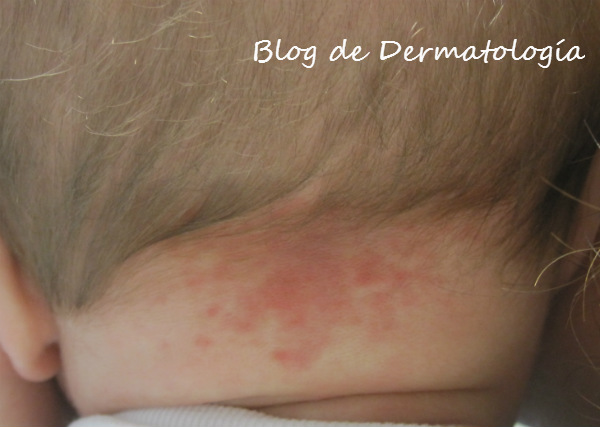
Today we will talk about some very characteristic marks on newborn babies, which can cause some concern for parents: salmon patches, also called nevus simplex.
What is a salmon patch?
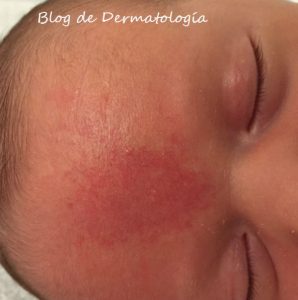
These are pink spots (single or multiple) with irregular outlines that appear on the forehead, eyelids, between the eyebrows, nape of the neck, or neck of babies. These spots are usually present from birth in 4 out of 10 newborns. Their color becomes more intense and the spots become more noticeable as the baby grows.
The salmon patch is present in 40% of newborns and usually becomes more noticeable when they cry.

Those located on the back of the neck and nape of the neck are often called “stork bites,” while those that appear on the bridge of the nose, between the eyebrows, or on the eyelids are called “angel kisses.”
Are salmon patches dangerous?
The exact cause of these spots is unknown, but it is known that, except in very rare cases, they are benign lesions and do not indicate any internal disease in the baby. They are not contagious and do not pose a risk of becoming malignant.
How are salmon patches diagnosed?
It is advisable to see a dermatologist or pediatrician to confirm the diagnosis, as salmon patches can be confused with other skin lesions such as other types of capillary malformations or hemangiomas. The diagnosis is simple to make and a clinical examination is usually sufficient.
How are salmon patches treated?
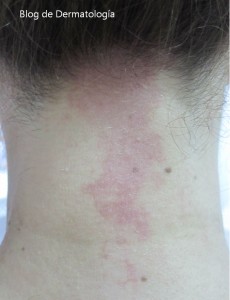
Salmon patches do not require any treatment. Those on the face (“angel kiss”) disappear on their own during the first or second year of life. Those on the back of the neck (“stork bite”) tend to last longer and are usually hidden by hair as it grows, persisting into adulthood.
The salmon patch on the face disappears, while those on the back of the neck usually remain until adulthood.
