In recent years, weather reports—both on television and online—have often included a segment on the so-called ultraviolet (UV) index, which is particularly important during the summer months since we know that UV rays are harmful to our skin. But do we know exactly what this refers to, and what does that “little number” they give us actually mean?
1.What is the UV index?
It is a number (greater than zero) that indicates the intensity of the sun’s UV radiation at the Earth’s surface. The higher this number is, the more damage the sun can cause to our skin or eyes, and the faster that damage will occur.
High SPF ratings indicate a higher risk of sun-induced skin damage and faster damage
2.Why was the UV index created?

In light of the clear increase in the incidence of skin cancer observed since the 1970s, the World Health Organization (WHO) promoted the creation of this index. In 1995, it was developed to provide a measure of the relative risk of sun-induced skin damage, based on our location and the time of day we are exposed. The idea was to warn people who are particularly sensitive to the sun of the risk when necessary.
The World Meteorological Organization, the United Nations Environment Programme, and the International Commission on Non-Ionizing Radiation Protection also participated in this initiative.
3.What is the UV index used for?
The purpose of this index is educational. The WHO recommends that it be reported in the media to raise public awareness of the risks posed by the sun, especially in the summer. That is why we hear about it on the news and on weather websites.
The UV index protects your health and can save lives
The UV index is considered to be:
- saving lives.
- protecting our health.
- helping maintain a youthful appearance
4.How should we interpret this?
The UV index varies throughout the day, peaking at noon. The media usually report this value—that is, the highest UV index expected during the day. On the State Meteorological Agency (AEMET) website, you can view hourly values for a specific geographic area by clicking on the value.
The media are reporting the maximum UV index forecast for the day, which will occur around noon
This value is usually a whole number: the higher the number, the greater the UV intensity at the Earth’s surface. Sometimes, two values may be provided, indicating the range of maximum intensity that can be expected during the day. This is used primarily for partly cloudy days when the intensity can vary depending on the position of the clouds in the sky.
The UV index also varies depending on the month. The highest values in Spain are usually recorded in late June and early July. This data is also available on the AEMET website.
The highest UV index readings in Spain are recorded in June and July
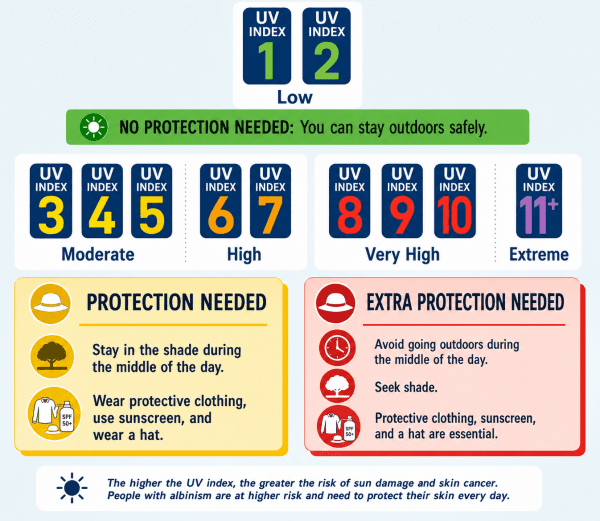
UV index values are classified as low, moderate, high, very high, and extremely high, as shown in the following table:

5.What is recommended based on the UV index value?
Las recomendaciones de la OMS según el valor del índice UV son las siguientes:
6.How is the UV index measured?
There are two ways to do this:
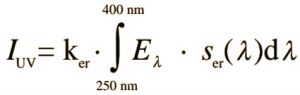
- using a device called a spectroradiometer and the following mathematical formula:
- using a broadband detector that has been calibrated and programmed to directly measure the UV index.
In Spain, the UV index is measured continuously using broadband UV radiometers at more than twenty stations in the AEMET National Radiometric Network, as well as by the AEMET Brewer spectrophotometers located in A Coruña, Zaragoza, Madrid, Murcia, Izaña, and Santa Cruz de Tenerife. Atmospheric ozone must also be taken into account when making forecasts.
You can find more information about the UV index at the WHO’s webpage on the subject.
