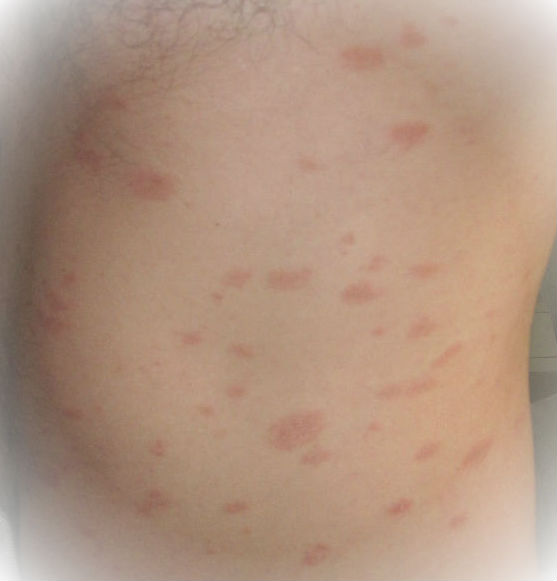
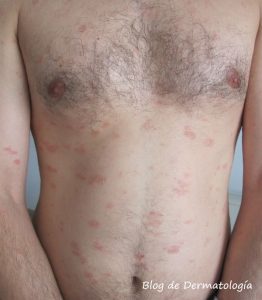
This week’s post is about pityriasis rosea. It is a disease (nothing serious, by the way) described by Camille-Melchior Gibert in 1860. It usually causes quite a bit of concern in those who suffer from it because it tends to appear suddenly, without any apparent cause, and spreads across the abdomen, back, and arms.
The good news is that it is fairly easy to diagnose and heals on its own, so once you know you have pityriasis rosea, you can rest assured.
Pityriasis rosea is quite common; it is estimated that 2 out of every 100 people who visit a dermatologist suffer from it. It usually occurs in older children or young adults, more frequently in females.
WHAT DOES PITIRIASIS ROSEA LOOK LIKE?
Pityriasis rosea usually appears as pink, generally oval spots scattered across the trunk, which tend to form imaginary horizontal lines, often referred to as a “Christmas tree pattern.” The patches may have a white scaly border. In addition to affecting the trunk, they can appear on the arms or legs (most frequently on the thighs and rarely below the knees). It is rare for them to appear on the face. In more than half of cases, the first spot is larger and appears alone (which we call “Broq’s heraldic medallion”), followed by other smaller spots.
They are oval, pink spots that appear on the trunk and do not usually itch.
Normally, these spots do not itch much and do not usually cause discomfort.
WHY DOES IT APPEAR?
The cause of this disease is not well understood. Recently, some studies have been published that seem to link it to certain types of viruses (including herpes viruses 6 and 7, as well as the flu virus), but their role in the development of this disease is not yet clear.
HOW IS IT DIAGNOSED?
The diagnosis can usually be made during a simple visit to the dermatologist, who must differentiate it from other skin diseases that may have similarities (eczema, psoriasis, pityriasis versicolor, etc.). No specific tests are necessary to confirm the diagnosis.
No tests are usually necessary to diagnose pityriasis rosea.
HOW IS IT TREATED?
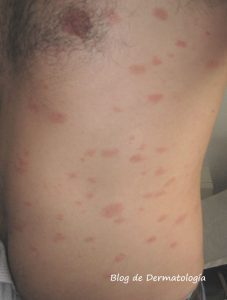
It is known to be a condition that disappears on its own within several weeks (even 2-3 months). In order to avoid unnecessary worry, it is very important to understand that it lasts for a while (which can be a long time) and that new spots may appear in the meantime. After a few weeks/months, the spots begin to disappear on their own and, in most cases, without leaving any marks.
It is usually recommended to apply a moisturizing cream to keep the skin well cared for during the process. On the other hand, although it is rare, some people experience itching from the spots caused by pityriasis rosea; in these cases, the doctor or dermatologist may prescribe a soothing cream or topical corticosteroid to relieve this discomfort.
Pityriasis rosea does not require treatment. It heals on its own.
IS IT CONTAGIOUS?
Pityriasis rosea is not contagious, and those who suffer from it can lead a completely normal life. The only thing to bear in mind is that if you are exposed to the sun while you have the spots on your skin, they may leave a kind of darker “mark” for a few weeks or months after healing, so we always recommend using sunscreen.
